Charlotte, NC
Our home since 2013.
352 North Caswell Rd., Charlotte, NC 28204 · (704) 910-5469
A historic house, not a glass tower
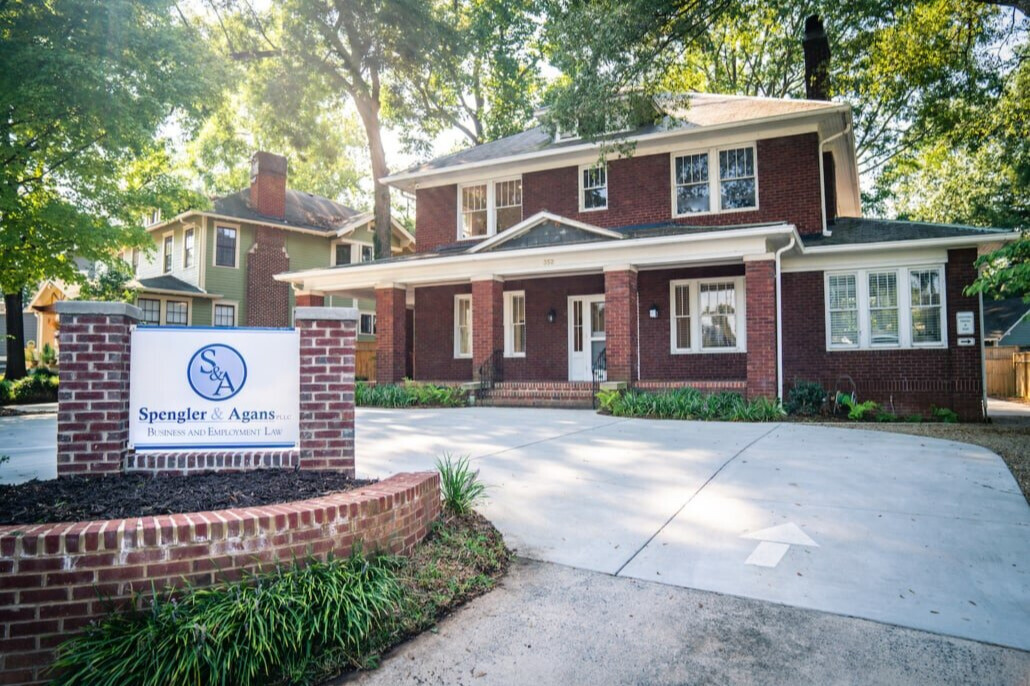
Spengler & Agans was founded in Charlotte in 2013. In 2018, the firm moved into a historic converted house on North Caswell Rd., a deliberate choice over a downtown office tower. It's a smaller, warmer space, and it fits how the firm operates: personal, direct, and far from a commodity legal-services assembly line. Charlotte's banking and financial-services base, and its expanding fintech, health-tech, energy, and advanced- manufacturing sectors, keep the firm's Startup & Business Law and M&A practices close to the businesses they serve.
Where a Charlotte business dispute actually gets heard
Most business disputes in Charlotte start in Mecklenburg County Superior Court, and cases that clear the federal thresholds go to the U.S. District Court for the Western District of North Carolina, which sits here in Charlotte. What sets North Carolina apart is the third option: the North Carolina Business Court, created in 1996 as a specialized forum for complex business litigation, with one of its four permanent locations in Charlotte and a resident Business Court judge on East Fourth Street.
Getting a case in front of that court is a procedural decision made at the very start, not a strategy you can adopt later. A case is designated a mandatory complex business case under N.C.G.S. § 7A-45.4, and the qualifying categories map closely onto the work we do: disputes over the law governing corporations, partnerships and LLCs, securities, antitrust, trademarks, intellectual property, and trade secrets. Those categories carry no amount-in-controversy threshold. A straight breach-of-contract dispute is treated differently; it needs at least $1 million in controversy and the consent of every party. The plaintiff's notice of designation must be filed at the same time as the complaint, so the choice of forum is effectively made on day one.
Why that matters to a business owner: the Business Court assigns one judge to a case from beginning to end and writes detailed published opinions. The result is a more predictable body of North Carolina corporate case law than a general civil docket produces, and it is a large part of why we draft agreements with an eye to where a dispute over them would land.
What North Carolina asks of your company every year
North Carolina's ongoing compliance burden is light compared with many states, which is exactly why it gets missed. An LLC formed here files an annual report with the North Carolina Secretary of State by April 15 each year, starting the year after its articles of organization take effect; corporations run on a deadline keyed to their fiscal year instead. Miss it and the Secretary of State can issue a notice of grounds for administrative dissolution, and an administratively dissolved entity is a problem that surfaces at the worst possible moment: in a financing, in a sale, or when a counterparty's lawyer runs a good-standing check mid-negotiation.
The same goes for your registered agent. Charlotte businesses routinely list a founder's old apartment or a co-working address and then never update it, and service of process goes somewhere nobody checks. We treat this as maintenance rather than a crisis. Our Startup & Business Law and Fractional General Counsel practices cover how that ongoing work is structured.
The Charlotte economy we practice in
Charlotte is one of the largest banking centers in the United States, and that concentration shapes the legal work here: the region's fintech, insurance-tech, and payments companies exist because the financial-services talent does. Around that core, the city has been building genuinely different sectors. The Pearl, an innovation district in Midtown, is anchored by the Wake Forest University School of Medicine-Charlotte, the region's first four-year medical school, and is drawing medical device and healthcare technology companies with it. UNC Charlotte has reached Carnegie R1 research status, which shifts the university's role in the local pipeline from talent source to research partner, and research partnerships bring their own intellectual property and licensing questions.
The practical consequences are the ones we see across the desk: life-sciences and health-tech founders working out IP assignment with a university, fintech companies whose product decisions are also data privacy decisions, and advanced-manufacturing businesses along the I-85 corridor whose contracts have to work across state lines.
Charlotte in brief
A short read on the local landscape. Reviewed August 2026.
City Hall is mid-transition
Vi Lyles stepped down on June 30, 2026 after five terms as mayor. City Council named Robert Harrington, president of the North Carolina Bar Association, interim mayor from July 1, serving the remainder of the term through December 2027. Businesses with matters in front of the city should expect the usual shift in priorities that follows a change at the top.
Venture funding has tightened
North Carolina startups raised roughly $2.3 billion in 2025, down more than 40% from the prior year and dropping the state from 7th to 15th nationally. Founders here are raising smaller rounds, later, on tougher terms. That is exactly when liquidation preferences and anti-dilution mechanics stop being boilerplate and start mattering.
The city is rewriting how it backs small business
Charlotte's Small Business Ecosystem Assessment, completed in late 2025, is being turned into an implementation plan that will steer how the city aligns its small-business investment. Worth watching if you are in line for city contracting or incentive programs.
The startup calendar still runs through PitchBreakfast
The firm has sponsored PitchBreakfast, Charlotte's monthly startup pitch event, for over a decade. The Seed the South Capital Summit has since grown into the region's larger annual gathering of Southeast founders and investors.
In the community
Eric Spengler and Justin Agans are both active locally - Eric as Secretary of the Villa Heights Community Organization, founder of the Friends of Queens Park nonprofit, a past President of the Mecklenburg County Bar's Civil Litigation Section, and a former Mecklenburg Soil & Water Conservation District Supervisor; Justin as a regular guest lecturer on entrepreneurship and a mentor to early-stage founders. Both partners are also involved in local animal-adoption causes, the office dog, Whiskey, was recently featured as "Mr. June" in the Humane Society of Charlotte's calendar.